

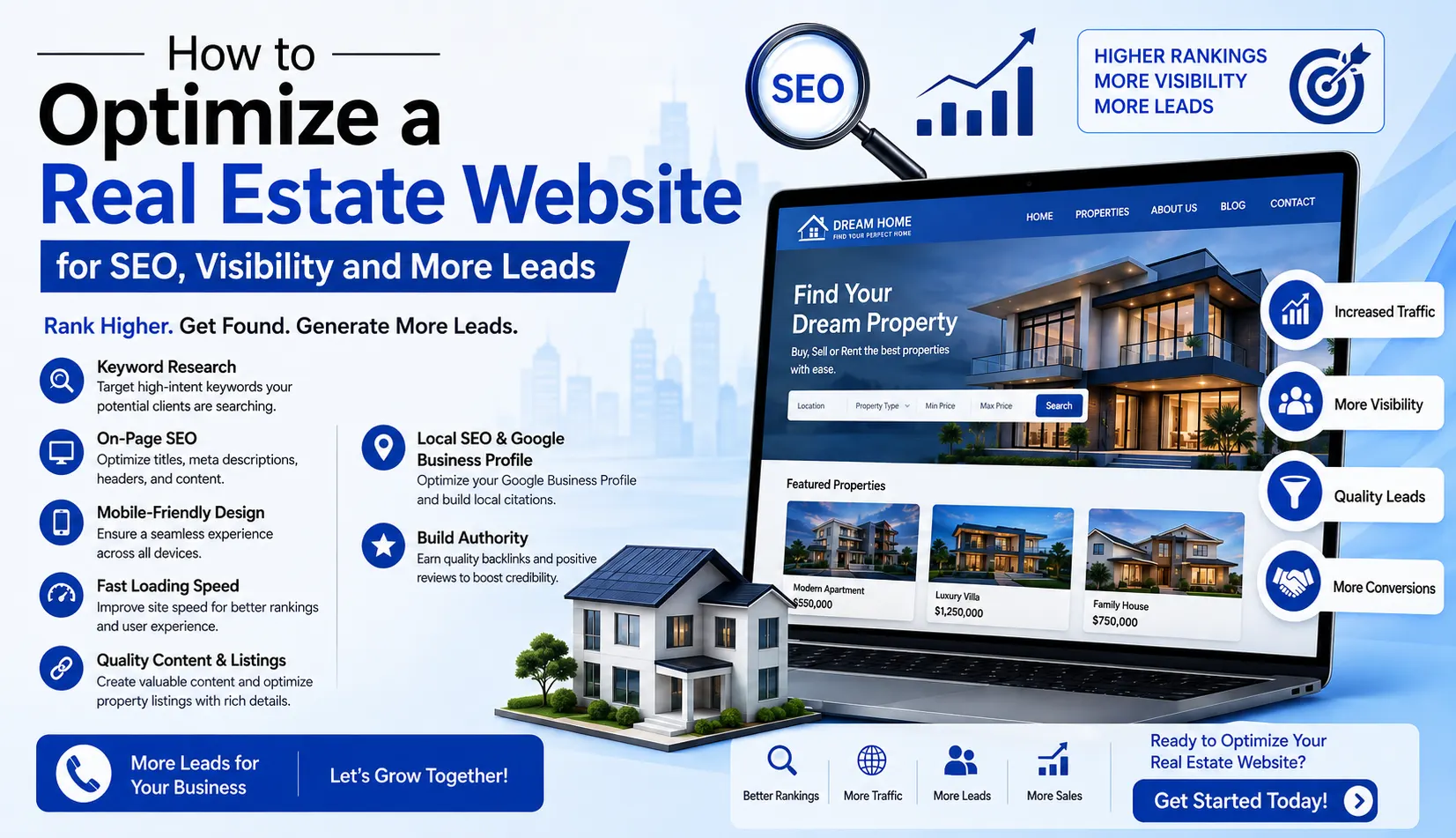
Did you know?
A real estate website is more than an online brochure.
For builders, developers, brokers, and real estate agents, it can become a continuous source of qualified enquiries when it is designed around how people actually search for properties.
The challenge is that real estate websites often contain hundreds or thousands of pages, large image galleries, property filters, location pages, and frequently changing listings. Without the right SEO and website structure, Google may struggle to crawl, understand, and rank those pages.
Why is optimisation important in ranking?
A well-optimized real estate website should therefore accomplish three things: help search engines understand the website, help buyers find relevant properties, and make it easy for visitors to enquire.
Here is a practical framework for doing it.
1. Design and develop the website around search intent
Start with what prospective buyers actually search for rather than simply optimizing the website around your company name.
Real estate searches usually fall into several categories:
- Location: flats in New Town Kolkata
- Property type: 3 BHK apartments in Kolkata
- Price: flats under ₹80 lakh
- Project: mention project name or apartments
- Requirement: ready-to-move flats in Kolkata
- Commercial: office space in Salt Lake
- Informational: best areas to buy property in Kolkata
The strongest opportunity is often the combination of location + property type + buyer intent. Current real estate SEO research increasingly emphasizes micro-market and intent-driven searches instead of relying exclusively on broad terms such as “real estate” or “property for sale.”
Also Read: How to do SEO for Real Estate Company
Create dedicated, useful pages for important combinations rather than forcing every keyword onto the homepage.
2. You have to create a logical real estate website structure
Your website architecture should make it easy for both users and search engines to understand the relationship between your pages.
A practical structure could look like:
Homepage → Locations → Property Types → Projects → Individual Properties
For example:
Properties → Kolkata → New Town → 3 BHK Flats → Project Page → Property Details
You can also create supporting content such as:
- New Town property buying guide
- Best residential areas in Kolkata
- 2 BHK vs 3 BHK comparison
- Property investment guides
- Local market reports
This structure creates natural internal-linking opportunities and helps search engines understand which pages are most important. Strong internal linking is particularly valuable for real estate websites because visitors frequently move between listings, locations, guides, and project pages before making an enquiry.
3. Optimizing every individual property and project page is important
Your property pages should not be simple templates containing a few photos, price, and a “Contact Us” button.
Each important project page should provide substantial, useful information.
Include:
- Project name
- Developer information
- Exact location
- Property types
- Configuration
- Price or price range where appropriate
- Amenities
- Floor plans
- Construction status
- Possession information
- Nearby schools, hospitals and transport
- RERA information where applicable
- Frequently asked questions
- High-quality photographs
- Location map
- Enquiry options
For Indian real estate websites, project-specific pages containing detailed project information can be particularly valuable because they address highly specific searches with strong commercial intent.
Avoid automatically generating hundreds of nearly identical pages. Thin or duplicate property pages can create crawl and quality problems, particularly on websites using property-feed or listing integrations.
4. Add targeted keywords in the titles, headings, and URLs
Every important page should have the target keyword in the title, heading, and URL.
Instead of:
Title: Home | ABC Realty
Use something more descriptive where appropriate and keyword added:
Title: 3 BHK Flats in New Town Kolkata | ABC Realty
For a project:
Title: [Project Name] in New Town Kolkata | Price, Floor Plans & Amenities
Keep URLs short and descriptive.
For example:
/properties/3-bhk-flats-new-town-kolkata/
or
/projects/project-name-new-town-kolkata/
Avoid URLs containing unnecessary IDs, random parameters, or confusing category structures.
5. Your website should load fast and be mobile-friendly
Real estate websites are particularly vulnerable to performance problems because they frequently contain large photographs, videos, maps, virtual tours, and third-party property tools.
Compress images without sacrificing useful quality, use modern image formats where appropriate, lazy-load images that are below the fold, and minimize unnecessary scripts. You can use cache plugin to optimise the website.
Pay particular attention to:
- Largest Contentful Paint
- Interaction to Next Paint
- Cumulative Layout Shift
- Mobile usability
- Server response time
- Image loading
Speed is not simply an SEO exercise. A slow property page can also prevent a potential buyer from viewing photographs, comparing properties, or submitting an enquiry. Recent real estate SEO guidance repeatedly identifies heavy images and listing integrations as common performance problems.
There are a lot of things apart from the above-mentioned points that need complete focus; we are here to help you in detail.
For real estate companies, the winning website is not necessarily the one with the most pages. It is the one that gives Google and potential buyers the clearest answer to every important property question.
Build the website around people, properties, locations, and intent, and SEO becomes part of the business infrastructure rather than just another marketing activity.
So, if you need help in optimising your real estate website, feel free to call us

The Crawl First editorial team is made up of digital marketing specialists, SEO strategists, and content writers based in Kolkata, India. With hands-on experience managing SEO and digital campaigns for businesses across West Bengal and India, the team writes practical, research-backed guides to help businesses grow their online presence.